
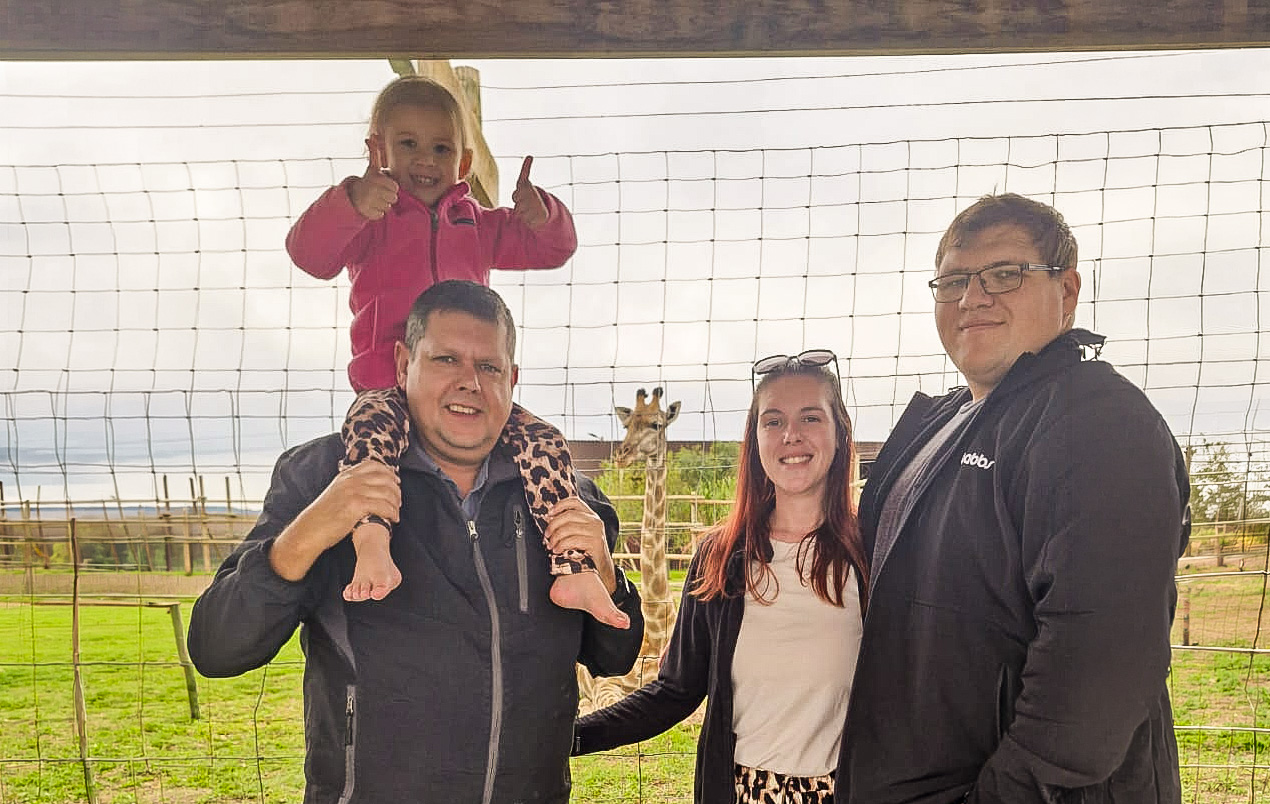
When little Milly Grace (affectionately called Gracie) began complaining of leg pain, her parents Marthinus and Linique Barnard didn’t think much of it. They assumed it was simply growing pains, nothing unusual and certainly nothing to worry about. She was a healthy active three-year-old and their GP agreed. But, two months later, Gracie felt dizzy and faint. Concerned, her parents took her for a more thorough check-up. Tests and scans revealed the diagnosis no parent wants to hear. Gracie was diagnosed with Neuroblastoma, a rare childhood cancer that develops in immature nerve cells called neuroblasts, and most often affects children under five. Her dizziness was caused by very low haemoglobin levels.
At the time of her diagnosis (a month ago), Gracie had none of the typical symptoms except for leg pain and low haemoglobin levels. Because of her haemoglobin levels, she has received one unit of blood and her medical team at Rondebosch Medical Centre is monitoring her white blood cell count to determine whether further transfusions will be needed.
For a three-and-a-half-year-old, hospital stays can be very scary. No one likes to be poked and prodded with needles. To help her cope, her father, Mathinus, himself a committed blood donor, with 16 donations to date, decided to show Gracie, that needles aren’t always scary. He took her along to his next blood donation at the Blue Route Mall Blood Donor Centre, letting her see that even daddy gets poked with needles and that bravery can be shared.
Marthinus and Linique would like to thank each and every blood donor. “Your selfless act of kindness helped our little hero when she needed extra love (blood) on her journey. They say it takes a village to raise a child, never did we realise that blood donors would be part of our village.”
So far, Gracie has completed one round of chemotherapy and is preparing for her second. She shows us how much courage can live in such a small body and how much love and strength can be drawn from her parents’ love and example.
People often think of donated blood as something used in emergencies, like car accidents, surgery or sudden trauma. But Milly Grace’s story shows us that blood donations are often lifelines for children fighting cancer and for patients with chronic illnesses. Every unit of donated blood carries hope for healing and another chance at a future. When people choose to donate blood, they’re giving children like Gracie the strength to face another treatment and take another step toward health.
Every day countless patients, young and old depend on blood donors. Let’s step forward, roll up our sleeves and give the gift of life.