
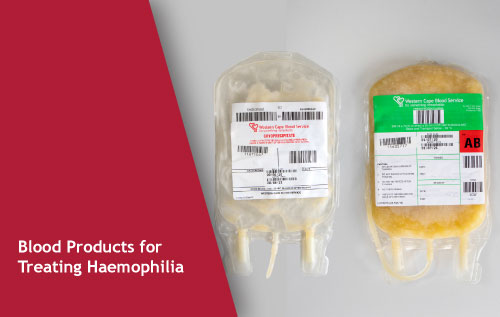
The Western Cape Blood Service (WCBS) ensures the availability of blood products necessary for treating haemophilia and other bleeding disorders by being a primary supplier of high-quality plasma to the local fractionator for the production of clotting factor concentrates, in addition to offering fresh frozen plasma (FFP) and cryoprecipitate (cryo) sourced from whole blood donations.
WCBS provides the National Bioproducts Institute (NBI) with more than 35,000 litres of plasma annually to produce plasma-derived medicinal products (PDMPs) for local sale. Clotting factor concentrates, such as factor VIII and factor IX concentrates, are clinically recommended for the treatment and prevention of haemophilia A/von Willebrand disease (vWD) and haemophilia B, respectively.
FFP is made by WCBS by separating the plasma from whole-blood donation (male donors only) within 6 to 18 hours after collection, and freezing the plasma to a core temperature of ≤ -30 °C within 60 minutes. This product contains all clotting factors at normal physiological levels.
Some of the clinically indicated uses for FFP in adults, based on evidence, include replacing inherited single-factor deficiencies when a specific factor concentrate is unavailable; addressing multiple coagulation factor deficiencies; reversing warfarin overdose in the absence of a prothrombin complex concentrate; and managing vitamin K deficiency associated with active bleeding. In paediatric and neonatal cases, FFP is indicated when there is a considerable risk of bleeding (INR or APTT >1.5); in cases of haemorrhagic disease of the newborn (while awaiting the effect of vitamin K); and for congenital coagulation deficiencies when a specific factor concentrate is not accessible or the deficient factor remains unidentified. WCBS provides adult FFP (non-leucocyte-reduced or leucocyte-reduced) and low-titre anti-T FFP units in approximately 280ml volumes, and paediatric leucocyte-reduced FFP units in approximately 130ml volumes. FFP should be administered using a standard blood administration set equipped with a 170µm to 240µm mesh filter within 6 hours post-thawing and transfused rapidly within 15 to 20 minutes to prevent deterioration of labile clotting factors. The initial recommended dosage for adults is between 10ml/kg and 15ml/kg of body weight, followed by a reassessment of the patient before continuing treatment. For paediatric patients, the recommended dosage ranges from 10ml/kg to 20ml/kg of body weight. It is advisable to use ABO-specific FFP, with group AB FFP being the preferred choice for neonates.
Cryoprecipitate (cryo) contains insoluble clotting factors and is produced by WCBS through a process of cold-thawing, spinning, and draining a pack of whole blood-derived FFP within 6-8 hours after collection. A single unit of cryo includes factor VIII and von Willebrand factor (vWF) — approximately 100IU per unit, fibrinogen ranging from 150mg to 200mg per unit, fibronectin, and factor XIII. Pre-storage pooled cryo (made from 5 units) is also available from all WCBS Blood Banks, containing a factor VIII concentration of at least 400IU and fibrinogen of at least 750mg. Some clinical indications for cryoprecipitate include the treatment of congenital or acquired hypofibrinogenaemia and hereditary factor XIII deficiency, and it has been advised for both obstetric haemorrhage and massive transfusion situations with a measurable fibrinogen deficit of less than 1.5g/l. WCBS provides a single cryo unit of approximately 10ml, a pre-storage pooled cryo product of around 50ml, and a single cryo unit of low-titre anti-T with a volume of about 10ml. Cryo should be administered using a standard blood administration set equipped with a mesh filter sized 170-240µm. It is essential to utilise it within 4 hours post-thawing and to transfuse it rapidly. The suggested dosage for adults is 1 unit of cryo per 10kg of body weight, or between 8-12 units per adult dose. For paediatric patients, the recommended dose is 5 ml/kg of body weight.
For additional information on plasma components and derivatives, please refer to the Clinical Guidelines for the Use of Blood and Blood Products in South Africa, 6th Edition, Chapter 6, titled Plasma Components and Derivatives.
For inquiries related to haemophilia, please contact the South Africa Haemophilia Foundation at https://haemophilia.org.za/.
Further Reading:
- Haemophilia A and B: Molecular and Clinical Similarities and Differences
https://pmc.ncbi.nlm.nih.gov/articles/PMC6717582/ - Factor XIII Deficiency
https://www.ncbi.nlm.nih.gov/sites/books/NBK557467/ - Cryoprecipitate Utilization Review in Light of Recent Guidelines: A Single-Center Prospective Analysis of Haemato-Oncology Patients
https://pubmed.ncbi.nlm.nih.gov/40930307/
For more information about NBI products, please visit their website at https://nbisa.org.za, or contact Nandipa Mabusela, NBI Marketing Manager, at Nandipa.Mabusela@nbisa.org.za.
For further details regarding blood products for the treatment of haemophilia and other bleeding disorders, please contact Dr Caroline Hilton, Lead Medical Consultant, at Caroline@wcbs.org.za.