
Have you ever wondered what happens to your blood after you leave the blood donation clinic? While your donation begins its journey to save lives, another important process is already underway behind the scenes. Before a single unit of blood can reach a patient, it undergoes a series of meticulous tests and at the heart of that process is a team most donors never see, the Reagents Laboratory.
So, What Exactly Is A Reagent?
A reagent is a specially prepared chemical solution used in laboratory testing to identify, measure or confirm the presence of specific antigens/antibodies in a blood sample. After you donate blood, laboratory scientists use specialised reagents to determine your blood group and perform other essential tests that help ensure every unit of blood is safe for patients.
These reagents work by reacting with specific markers, known as antigens, on the surface of red blood cells. When a matching antibody binds to an antigen, the red blood cells clump together in a process called agglutination. By observing this reaction, laboratory scientists can accurately identify blood groups and confirm blood compatibility, helping ensure patients receive the right blood when they need it.
Why Is the Reagents Laboratory So Important?
Before blood can be transfused, it must be thoroughly tested. Every donor’s blood is tested to determine important blood groups such as ABO and Rh, but that’s only part of the story. Scientists also look for many other blood group antigens and antibodies that could affect safety of a transfusion. Today, there are 48 internationally recognised blood group systems, each with different combinations of antigens that can influence compatibility between donor and patient. The Reagents Laboratory produces and supplies the specialised reagents needed to perform these tests accurately. Without these reagents, laboratory staff wouldn’t be able to confidently identify compatible blood for patients who need transfusions. That accuracy gives doctors confidence, provides patients with safer transfusions and ensures blood reaches the people who need it most.
What Happens in The Laboratory
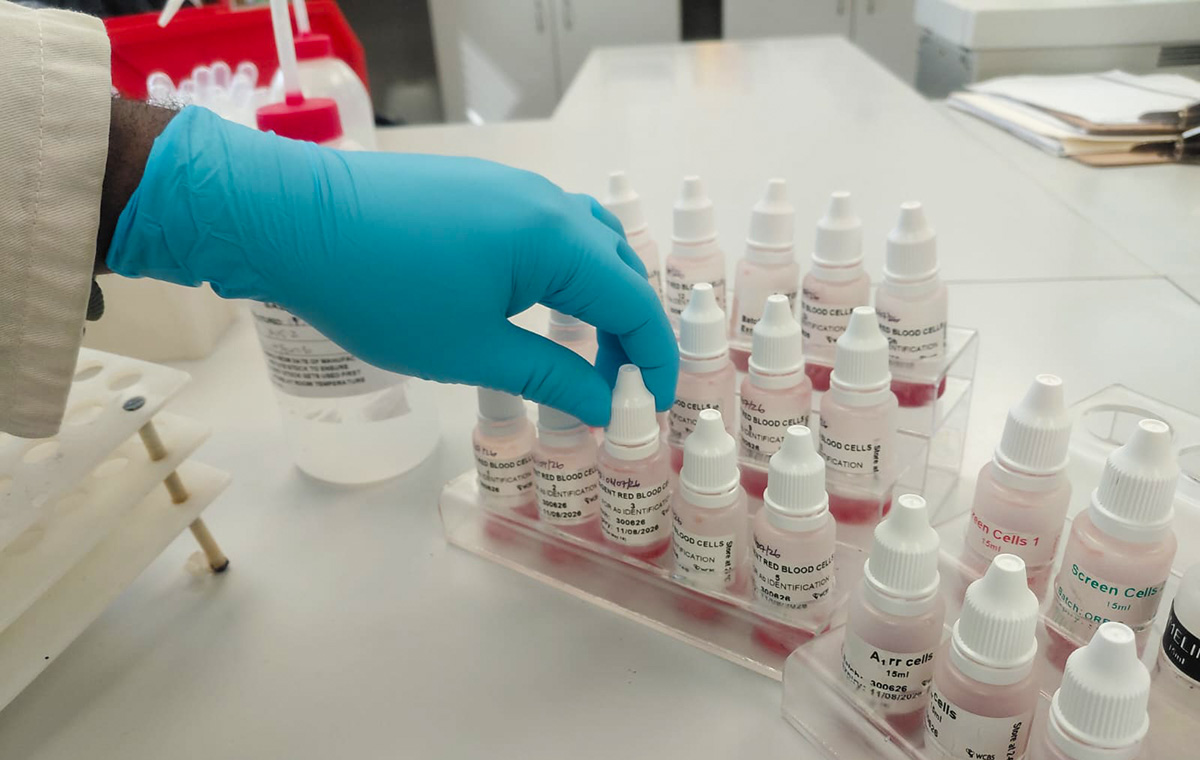
When people hear “laboratory,” they often imagine scientists mixing colourful liquids in test tubes. The reality is far more detailed. Every day, the Reagents Laboratory prepares chemical solutions using highly purified reverse osmosis (RO) water. approximately 100 litres of purified water can be used daily to make solutions such as saline, phosphate buffered saline and other specialised laboratory products. Each solution must be prepared according to strict procedures. Every container is carefully labelled, tagged and documented to ensure complete traceability.
Once solutions are ready, the team prepares the blood grouping reagents themselves. This involves contacting donors, testing of donor’s whole blood, washing cells, performing quality tests, documenting every step and checking that every batch performs exactly as expected before it can be used. Nothing leaves the laboratory without passing rigorous quality control which include initial testing of blood or reagents prior to production and final testing after the product has been produced. The team also bottles, labels, packages and distributes reagents to laboratories where they’re needed for donor and patient testing.
Quality You Can Trust
At WCBS, accuracy isn’t optional. The Reagents Laboratory adheres to internationally recognised quality standards, including ISO 15189 for medical laboratories and ISO 13485 for medical devices. These standards ensure that every reagent is manufactured, tested and documented consistently. This means laboratory scientists across our organisation can trust the reagents they use every day. And when lives depend on accurate blood testing, that confidence matters.
The Donors Who Make It All Possible
Perhaps one of the most fascinating aspects of the Reagents Laboratory is that some of its most valuable resources come from donors themselves. These individuals are specially selected to become Reagent Donors, donating specifically to support laboratory testing rather than for patient transfusions.
A Reagent Donor has been extensively tested to determine their complete red blood cell antigen profile. Scientists know exactly which antigens are present and which are absent on their red blood cells. Because of these well-defined characteristics, their red blood cells are used as reference cells in blood group testing. These reference cells help scientists confirm that laboratory tests are working accurately, ensuring reliable blood grouping and compatibility testing for patients who need transfusions.
Rare Donors and Antibodies That Support Blood Testing
The Reagents Laboratory also works with rare antisera containing known antibodies, such as Anti-D. People usually develop these antibodies after pregnancy or following a blood transfusion. These rare antibodies are essential for laboratory testing because they help identify matching antigens on blood cells and ensure patients receive the safest possible blood. Finding and maintaining these rare testing materials requires careful sourcing, quality control and scientific expertise.
Every Donation Supports Science
Most donors think about the patient who receives their blood, but some donations play an equally important role behind the scenes. Certain blood donations help improve laboratory testing, strengthen quality control and solve complex blood compatibility cases. Every accurate blood group result begins long before blood reaches a patient. It starts with dedicated laboratory professionals, carefully prepared reagents and, in many cases, generous donors whose unique blood characteristics help make safer transfusions possible.
Thank You for Being Part of The Journey
Every blood donation has a story that extends far beyond the donation chair. Behind every successful transfusion is an entire team working quietly behind the scenes to ensure every drop of blood is tested with precision and care. The Reagents Laboratory is one of those hidden teams, combining science, quality and donor generosity to help save lives every day. The next time you roll up your sleeve to donate, remember that your contribution could do more than help a patient. It could help improve laboratory testing, support life-saving research and strengthen the safety of every blood transfusion.
Your blood truly goes further than you think.